- Home /
- Guides/ Sports cards/ Hockey cards: Young Guns and what makes a card expensive
Hockey cards: Young Guns and what makes a card expensive
For a long time, hockey cards have in practice been Upper Deck's world. The company has held the NHL licence for decades, and most of what is sold is its series. The single most important term is Young Guns – the rookie cards in Upper Deck's base set. They are what collectors chase most, and they carry the value in almost every box.
Quick facts
| Largest manufacturer | Upper Deck |
|---|---|
| Most important card | Young Guns, the rookie cards in the base set |
| Leagues covered | NHL, AHL and CHL |
| Season labelling | Two years, such as 2025-26 |
| Format | Hobby box, blaster, mass blaster, gravity feed, retail display |
| Card size | Standard, 63.5 × 88.9 mm |
Young Guns explained
Young Guns is a subset within Upper Deck's base set, where each card shows a player in his first NHL season. The cards turn up at a fixed rate per box, and that rate is printed on the packaging. This means you do not have to guess how many you can expect.
Opening Young Guns is like a lottery ticket with known odds. A card of a player who later becomes a star becomes much sought after, but the vast majority of players never do. That is the whole mechanism of a hockey pack, and if you understand it, you buy for the players and for the collecting, not as an investment.
The series you will come across
Upper Deck Series 1 and 2 are the base set, and that is where most of the Young Guns are found; Extended Series adds more Young Guns later in the season. MVP is the affordable series with a large print run and a good starting point if you want to learn what the cards look like without paying hobby prices. SP is the premium series with smaller print runs, and Artifacts is the series built around memorabilia and autograph cards. Clear Cut is printed on a transparent base. Outside the NHL there are the AHL and CHL – the farm league and the junior league – where many players get their very first card, and where you can spot tomorrow's NHL players early if you follow the leagues.
O-Pee-Chee
O-Pee-Chee was a Canadian confectionery company from London, Ontario, that released its first hockey cards in the mid-1930s, and Upper Deck revived the brand in the 2006-07 season. The series is large – 600 cards in the 2023-24 edition, of which 100 are All-Star and Marquee Rookie cards with a smaller print run. Every pack has an OPC Retro card in an old design, and Marquee Rookies are the series' rookie cards.
The chase cards are Marquee Rookies of players such as Connor Bedard, Luke Hughes and Matthew Knies, along with the Hobby-exclusive OPC Retro Black Border cards, numbered to 100 copies.
Upper Deck Parkhurst
Parkhurst was founded as a hockey card brand in 1951-52, and Upper Deck uses the name for a series with a retro design. Parkhurst Champions is a separate series. The 2025-26 edition had 200 base cards and 50 short-printed rookie cards, and a hobby box with 16 packs of eight cards gives on average one signed card, four serial-numbered parallels, 16 rookie cards and 16 cards from 1954-55 Parkhurst Retros. The parallels carry names from the brand's history, such as Est. 1951 Gold and 1954-55 Wrapper Back, and the insert sets include cards with Canadian birds, fish and provinces. The edition was also available in blasters.
The chase cards are Est. 1951 Gold Spectrum in a single copy, 1954-55 Wrapper Back numbered to 15 copies, the signed patch cards – on average one per case – and the hard-to-pull insert sets Hockey Comics and Take it Outside!
Upper Deck PWHL Hockey
Upper Deck PWHL is Upper Deck's main series for the women's league Professional Women's Hockey League, where Upper Deck is the league's official card partner. The first edition, 2024 Upper Deck PWHL, came out in January 2025 with 50 base cards and 20 Young Guns. It was the first traditional card series for the league, but it had no autographs. These were added in the second edition, 2024-25. The 2025-26 edition has base cards 1–50, Young Guns 51–70 and the subset Postseason Standouts 71–80 with photos from the playoffs for the Walter Cup. A hobby box has twelve packs of six cards, and the edition was also available in blasters.
The chase cards are Gold Outburst in a single copy, the signed Signature Sensations cards and the rare insert sets Fearless Leaders – on average one card per 576 packs – and Magnifique.
Fleer Ultra PWHL
Fleer Ultra PWHL is the Fleer Ultra series' edition for the women's league Professional Women's Hockey League, and the 2025-26 edition was the first. Upper Deck bought the Fleer brand in 2005. The design follows Fleer Ultra for the NHL, while the subset Base 1999 Variations uses an older Fleer Ultra design. The insert set Medallions comes in colour parallels down to a single copy, and signed cards turn up on average four per case of hobby boxes.
The chase cards are Black Medallions in a single copy, the Fresh Ink autographs at an average of one per 150 packs, and Emerald Green Medallions in ten copies.
Upper Deck USA Hockey Juniors
USA Hockey Juniors is Upper Deck's series about the US junior national teams, and the first edition came out in 2026 with the men's U20 and U18 teams and the women's U18 team. The base set has 150 cards: 70 in the main set, 30 in the subset National Talent and 50 Star Shots, on average one per eight packs. A hobby box with 15 packs of six cards gives on average four autographs or jersey cards and four serial-numbered cards. The parallels go down to Outburst Gold in a single copy, and the insert sets include License to Ice on acrylic and Symbolism in lenticular print. The 2026 edition was also available in blasters.
The chase cards are Outburst Gold in a single copy, the signed patch cards numbered to at most 99 copies, and the signed Freebirds and Pledge Allegiance cards in ten copies or a single copy.
Upper Deck Series 1 and 2
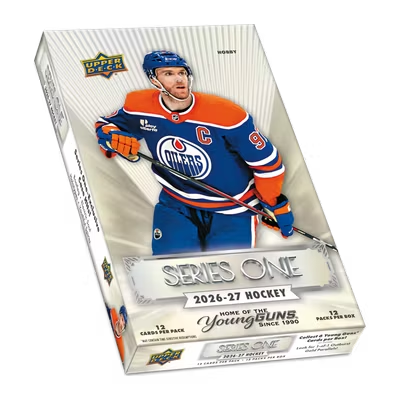
Upper Deck's base set in NHL hockey is released in two parts per season, and Series 2 continues the numbering where Series 1 ends. Each part has 50 Young Guns – the rookie cards for the season's new NHL players – numbered 201 to 250 in Series 1 and 451 to 500 in Series 2. Beyond these, collectors chase the UD Canvas cards and the numbered parallels Exclusives, in 100 copies, and High Gloss, in 10 copies.
The chase cards are Young Guns of high-profile rookies, such as Matthew Schaefer, Michael Misa and Zeev Buium in the 2025-26 edition, along with the High Gloss parallel in ten copies and the UD Canvas Young Guns variants in a very small print run.
Upper Deck MVP
MVP comes out early in the hockey season and is the first series with the season's NHL cards, mainly in retail formats such as blaster, fat pack and display. The base set has 250 cards, and the last 50 are a subset of rookie cards and short-printed cards. The rare cards are the Super Script parallels numbered to 25 copies and Black Super Script in 5 copies, and some packs have redemption cards for rookie cards.
The chase cards are Black Super Script in five copies, Draft Pick SP Redemption in gold at an average of one per 12,500 packs, and the Magenta autographs of selected players.
Upper Deck SP
SP is Upper Deck's retail series in NHL hockey and is sold in blasters and hangers. It should not be confused with SP Authentic and SP Game Used, which are separate series. The base set has 100 veterans and 40 cards in the subset SP Rookie Authentics, numbered to 1,299 copies, and the rare cards include signed SP Rookie Authentics and jersey relic rookie cards.
The chase cards are the signed SP Rookie Authentics and the jersey relic rookie cards of players such as Connor Bedard, Logan Cooley and Adam Fantilli, all numbered to at most 1,299 copies.
Upper Deck Artifacts
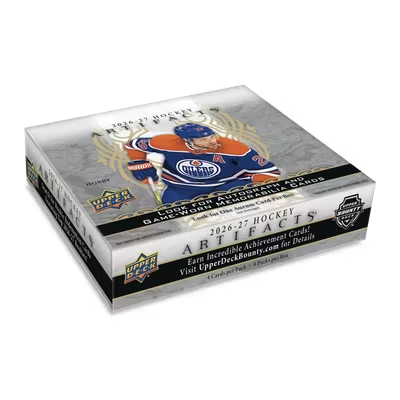
Artifacts is Upper Deck's series for memorabilia cards and autographs early in the hockey season. A hobby box has on average three cards with an autograph, a memorabilia piece or a special technique, plus a redemption card for rookie cards or a Clear Cut card in acetate. The rookie cards are 50 redemption cards that are exchanged for cards of the season's debutants, and the insert set NHL Remnants has pieces of game-worn jerseys.
The chase cards are NHL Remnants with pieces of game jerseys, the autographed Rookie Redemption cards of players such as Luke Hughes and Devon Levi, and Connor McDavid's black parallel in five copies.
Upper Deck Allure
Allure is Upper Deck's chrome-like hockey series, built around colour-coded parallels that collectors try to collect in every colour for the same player. The hobby box has one guaranteed signed card, and the base set mixes veterans with 50 rookie cards from the season's draft class. The numbered parallels go from Gold Glitter Bomb in 199 copies down to Golden Treasures in a single copy.
The chase cards are Golden Treasures in a single copy, the rookie cards of players such as Ivan Demidov, Matthew Schaefer and Michael Misa, and the rare image variations of stars such as Connor McDavid and Connor Bedard.
Upper Deck Clear Cut
Clear Cut has a single card per box, encased and printed on transparent acetate. The base set consists of signed cards of veterans, legends and rookies, with parallels down to a single copy, and the insert set Retro Rookies Autos consists of signed acetate versions of well-known rookie cards from earlier series. The 2022-23 edition was a combined series with NHL cards from both 2021-22 and 2022-23.
The chase cards are the signed Legend Autos of former stars, Retro Rookies Autos in classic designs such as 2014-15 Young Guns, and the UD High Gloss parallel, numbered to ten copies.
Upper Deck Premier
Premier sits high in Upper Deck's hockey range, with a single pack of six cards per box, of which four are signed cards or memorabilia cards. Each box should have a signed patch card in acetate, and the rookie cards in that subset are signed directly on the card and numbered to at most 249 copies. The series also has memorabilia cards with two, three and four players on the same card.
The chase cards are Premier Mega Patch with large jersey pieces in a very low print run, the signed patch rookie cards in platinum in a single copy, and the memorabilia cards with three or four players on the same card.
Upper Deck AHL
Upper Deck AHL has cards of players in the American Hockey League, and Upper Deck presents it as the place to find the NHL stars of the future. The base set has 150 cards, of which 50 are Star Rookies that come one per pack, and the hobby box has on average one signed card. The insert sets cover the league's best newcomers, All-Star players and goaltenders.
The chase cards are the rare autographs of players such as Stefan Noesen, and the rookie cards of players such as David Jiricek and Jesper Wallstedt in the insert set Stars of Tomorrow.
Upper Deck CHL
Upper Deck CHL brings together the three junior leagues in the Canadian Hockey League – OHL, QMJHL and WHL – where many NHL players play before the draft. The main set is large, 400 cards in the 2022-23 edition, with the subsets Base Stars and Star Rookies. The insert set First Draft shows high-profile picks in the leagues' own draft, and the 2022-23 edition had dedicated cards about Connor Bedard's time in the WHL.
The chase cards are Connor Bedard's rookie cards and his dedicated insert set Connor Bedard Retrospective, along with CHL Graduates with legends such as Wayne Gretzky, Connor McDavid and Sidney Crosby.
Upper Deck Team Canada Juniors
Team Canada Juniors has cards of Canada's youth national teams in hockey, and the 2023 edition included the men's under-18 and under-20 teams as well as the women's national team. The hobby box has on average at least four cards with an autograph, a memorabilia piece or a special technique. The subsets Pride of the Program and Program of Excellence also come as signed memorabilia cards, numbered to at most 175 copies.
The chase cards are Connor Bedard's signed cards in the Black parallel, numbered to five copies, and the signed memorabilia cards in Pride of the Program and Program of Excellence.
Upper Deck Star Rookies
Star Rookies is a complete box set with the season's NHL rookie class, where each box has 25 base cards and one parallel. The parallels come in decreasing print runs, from blue and gold down to red in 75 copies and green in 5 copies. Roughly every twentieth box has a signed card, and the black signed cards exist in a single copy.
The chase cards are the black signed cards in a single copy and the rookie cards of highly ranked newcomers such as Ivan Demidov, Matthew Schaefer and Michael Misa.
SportZoo SHL
SportZoo is a manufacturer from Bratislava in Slovakia that makes official trading cards for the SHL and has made cards and stickers in Central Europe since 2016. The SHL season is released in three parts: Serie 1, Serie 2 and Playoffs. The Playoffs edition is about the playoffs and has cards with pieces of goal nets, jersey material and the biggest moments of the playoffs.
Upper Deck SPx
SPx started as a hockey series in the 1996-97 season and is known for holograms and cards in acetate and PETG. With the 2024-25 edition, the series went from one pack per box to hobby boxes with eight packs of three cards. The 2025-26 edition had a base set of 165 cards: 100 veterans, 50 rookie cards and 15 Rookie Holograms in a harder subset. A hobby box gave on average four rookie cards, three Silver parallels, one Gold parallel, two numbered Finite inserts and four hologram or PETG inserts. The insert sets include Holoview F/X and Game Film, and the parallels go down to Gold Spectrum in a single copy.
The chase cards are Rookie Holograms – a hard subset with parallels down to gold in a single copy – the signed Finite Rookies and the Gold Spectrum parallels in a single copy.
Upper Deck Fleer Ultra Hockey
Fleer Ultra is a series under the Fleer name that Upper Deck releases in NHL hockey. For several seasons it was only available in Upper Deck's digital ePack, where the cards could be redeemed as physical cards, and with the 2025-26 edition it came back as a hobby box. The base set in that edition had 200 cards: 100 veterans, 50 short-printed cards and 50 rookie cards. A hobby box with 15 packs of eight cards gave on average nine Rainbow Foil parallels, four serial-numbered parallels and six cards from Medallions or Rising Stars. Medallions comes in colour parallels down to a single copy, and signed cards are rare: The rookie card autographs came at an average of one per 75 packs.
The chase cards are the Gold Spectrum parallels and the highest Medallions parallels in a single copy, along with the insert sets Rink Producers in acetate and Angulars, at an average of one card per 450 packs.
Upper Deck Flair Hockey
Flair arrived in 1993 as a series with glossy, thick card stock and has existed in several sports. The 2025-26 edition was the first stand-alone Flair edition in hockey since the 1996-97 season, now under Upper Deck, with three photos per card as in the original and reinterpreted inserts such as Hot Mitts and Wave of the Future. The base set had 200 cards, of which 50 were rookie cards, and image variations in the 1990s Flair style, among them 1993 Variant. A hobby box with ten packs of four cards gave on average four serial-numbered base cards and five inserts, and a case of ten boxes gave on average four signed cards.
The chase cards are the image variations in Spectrum in a single copy, 1993 Variant numbered to 93 copies, and the insert sets Touch of Flair, with heat-sensitive ink that reveals a hidden image, and Flash + Flair, where the Flair version came at an average of one per 250 packs.
Upper Deck Skybox E-X Hockey
E-X is a SkyBox series from the 1990s. Back then, E-X2000 came out in basketball in 1996-97 and in American football and baseball in 1997, but not in hockey. Upper Deck released the hockey edition as 2023-24 Skybox E-X 2000 Hockey, with 150 cards, Credentials parallels in seven tiers from 499 copies down to VIP Credentials in a single copy, and hand-signed Autographics. The 2026-27 edition got a new design and a base set of 90 cards – 60 veterans and 30 rookie cards – and a hobby box with twelve packs of four cards gives on average one autograph, one die-cut parallel and twelve rookie cards.
The chase cards are VIP Credentials in a single copy, Gold Essential Credentials numbered to ten copies, and the insert set Unicorns, at an average of one card per 1,200 packs.
Upper Deck Ice
Upper Deck Ice is the series with cards in acetate. Its rookie cards are called Ice Premieres and are printed in numbered tiers. With the 2025-26 edition, the series was rebuilt as a hobby box with a single pack of eight cards, all at least 60pt thick and with hand-signed autographs. The base set has 100 cards, and Ice Premieres has 100 rookie cards in four tiers, from 999 down to 99 copies. A box gives on average one autograph, one jersey or patch card, one numbered Ice Premieres card and one card from Sub Zero or Black Ice. Exquisite Collection, which in 2024-25 was included as a series within the series, is not part of the 2025-26 edition.
The chase cards are the Champagne Gold parallels in a single copy, the highest tier of Ice Premieres in 99 copies, and the acrylic cards Dry Ice and Exquisite Crystal.
Upper Deck Ultimate Collection
Ultimate Collection is Upper Deck's hockey series in a box with a single pack of four cards. On average three of them are autographs, jersey or patch cards or cards with a special technique, and the fourth is a base card or an insert. The base set in the 2025-26 edition had 75 veterans and 25 legends, all numbered to 149 copies. The Ultimate Rookies rookie cards are numbered to 299 or 99 copies and also come with a jersey swatch, a patch and a signed patch. The insert sets include Ultimate Introductions, Ultimate Phenoms and Ultimate Signatures, and the 2025-26 edition also had cards from the 4 Nations Face-Off tournament with Canada, Finland, Sweden and the USA.
The chase cards are the Shield patch cards in a single copy, the signed patch cards in Ultimate Rookies, the Ultimate Emblems autographs with engraved metal and the Black parallels in a single copy.
Upper Deck Black Diamond
Black Diamond is Upper Deck's hockey series with diamonds as its theme, and as early as the 1996-97 edition the cards were divided into tiers with one, two or three diamonds. In the 2024-25 to 2026-27 editions, a hobby box is one pack of six cards: on average one autograph or Diamond Relic card, one card from Exquisite Collection, one base card or parallel, and three other inserts, jersey cards or special technique cards. The Diamond Relic cards have embedded lab-grown diamonds – one, two, three or four stones. The base set in the 2026-27 edition has 95 cards numbered to 399 or 349 copies, with Green in ten copies and Gold in a single copy.
The chase cards are Pure Black Diamond Relic in a single copy, the Diamond Relic cards numbered to five copies and the Gold parallels in a single copy.
Upper Deck Skybox Metal Universe Hockey
Metal Universe is a SkyBox series with roots in the 1990s that Upper Deck releases in NHL hockey. Its hallmark is the Precious Metal Gems (PMG) parallels: Red, Blue, Green and Gold, where Gold exists in a single copy. The base set has 150 cards in the 2025-26 and 2026-27 editions, and the last 50 are rookie cards, on average one per pack. A hobby box has 15 packs of six cards, and some boxes are Hot Boxes with a Blue PMG numbered to 50 copies in every pack. The series is also available in blasters with their own FX parallels, and the 2023-24 edition had the insert sets Jambalaya in lenticular print and Metal-X in acetate.
The chase cards are Gold PMG in a single copy, Green PMG in ten copies and the rare insert sets, such as Jambalaya in the 2023-24 edition, at an average of one card per 960 packs.
What makes a hockey card expensive
Rookie cards are the basis of every explanation, especially Young Guns of players who made their breakthrough. Next come autographs, where an autograph signed directly on the card is valued higher than one on a sticker attached to the card, and memorabilia cards with a piece of game jersey or equipment inserted into the card. Low numbering raises the price for the usual reason, and a confirmed grade makes a big difference on older cards.
The top tier is narrower than in football and almost always comes down to the same thing. It includes Young Guns of players who became stars: cards that were printed in a completely normal print run, but whose players later dominated the league. Then come low-numbered parallels in ten or so copies or fewer, signed rookie cards with the autograph directly on the card, and memorabilia cards where the piece can be linked to a specific game. Finally, there are graded copies of older rookie cards: Cards from the eighties and nineties in top grades are rare precisely because almost nobody stored them correctly. In other words, a hockey card rarely becomes expensive because of the series itself, but because the player had a career and because there are few copies in fine condition.
How to read the card
| Series name | On the front or back, such as Upper Deck Series 1 |
|---|---|
| Season | Two years, such as 2025-26 |
| Card number | On the back. Young Guns have their own number sequences |
| Rookie marking | The Young Guns logo or a rookie symbol |
| Numbering | Printed number of copies on parallels |
| League | NHL, AHL or CHL is clear from the series |
Which product should you buy
If you are chasing Young Guns, Upper Deck Series 1 or 2 in a hobby box is the one to choose. If you want to open a lot for little money, MVP is the right choice, with a large print run and a low price per pack. If you are chasing autographs, you buy SP or Artifacts. If you want to find future stars early, CHL is the way to do it. And if it is a gift, a blaster or mass blaster works best: They are made for opening, not for working out the numbers.
Mistakes that cost money
The most common one is believing that all rookie cards are Young Guns; Young Guns is a specific subset, not a collective name. Almost as common is comparing a hobby box with a blaster as if they contained the same thing. They do not, and you can see it in the odds on the packaging. Buying a whole box to find a specific player almost always costs more than buying the card. Storing the cards without card sleeves soon costs you, since chrome cards scratch easily. And it is easy to miss that the same player appears in many series with as many price levels, which means two listings for “the same card” can differ tenfold without either of them being wrong.
Getting started
- Decide what you collect. A team, a player or a season. Without that decision you buy a bit of everything and never finish anything.
- Start with an affordable series such as MVP to learn what the cards look like.
- Put the cards you want to keep in penny sleeves as soon as you open the pack.
- Sort them in a card storage box with card dividers by team or series.
- Fill gaps by buying single cards. This is almost always cheaper than opening more boxes.
Frequently asked questions
- What is a Young Guns card? The rookie card in Upper Deck's base set, the most collected subset in hockey.
- Are there Swedish hockey cards? Yes. SportZoo makes the official SHL cards, and Swedish players also appear in the NHL series. Read more in the guide to Swedish hockey cards and SHL cards.
- What does 2025-26 on the box mean? The season the cards cover.
- Are AHL and CHL cards worth anything? Sometimes. That is where many players get their very first card.
- Is grading worth it? Often, on expensive rookie cards. See the grading guide.
From our range
 Hockey cards
2026-27 Upper Deck Artifacts Hockey Hobby Box
 Hockey cards
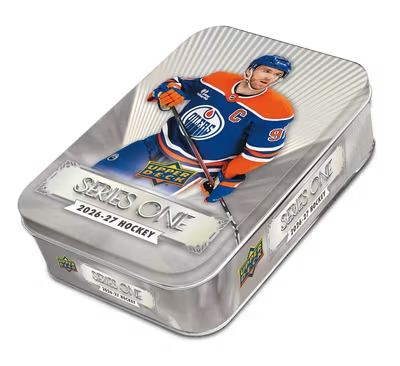
2026-27 Upper Deck Series 1 Hockey Tin
 Hockey cards
2026-27 Upper Deck Series 1 Hockey Hobby Box
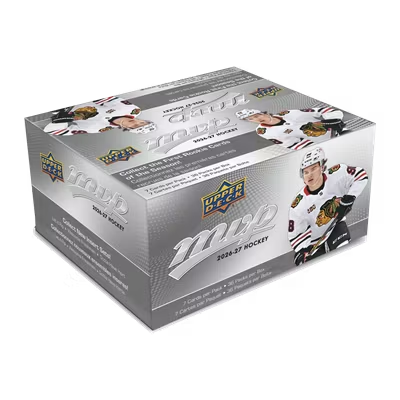
Read more about Swedish hockey cards and SHL cards, rookie cards and parallels and numbered cards.
Shop: hockey cards at Bangerpack.
Written by us, the people who run Bangerpack. Our range and prices change all the time. The category shows what applies when you read this.