- Home /
- Guides/ Prices and the market/ Why do trading cards cost what they do?
Why do trading cards cost what they do?
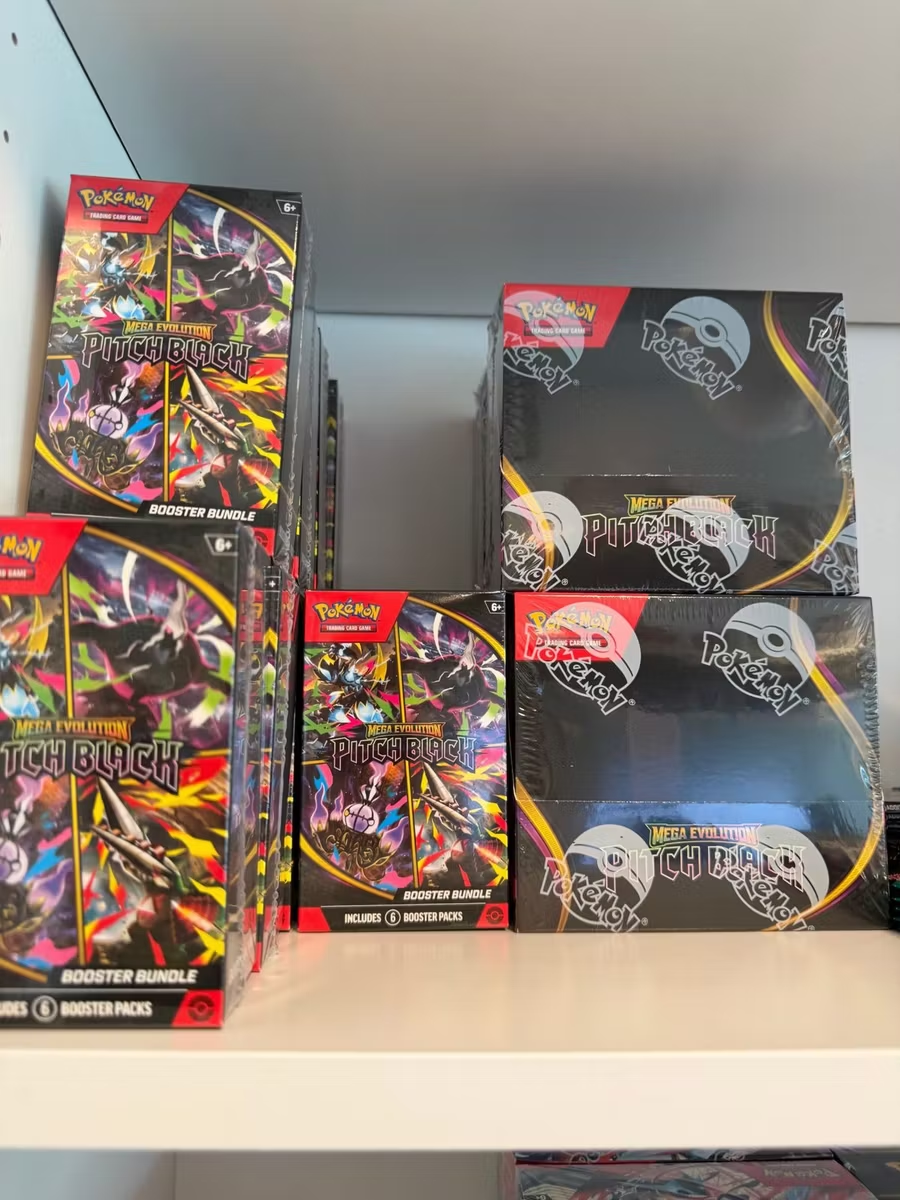
The price of a sealed card product is set by three things: what the shop actually paid for it, what has to be added on top to get it to your door, and how many copies were available to buy. The last one weighs the most. When the manufacturer ships fewer boxes than retailers ordered, the price rises along the whole chain, long before the product reaches a shop shelf.
Quick facts
| VAT | Included in the price you see, and passed on to the state in full |
|---|---|
| What the shop gets to keep | The price minus VAT, purchase cost and expenses |
| Largest single item | The purchase price from the distributor |
| What drives the purchase price | Allocation, meaning how much is allotted |
| Why European prices differ from American ones | VAT, shipping, customs and an extra distribution step |
| What does not drive the price | What the customer thinks the product should cost |
What goes into the price you pay
| Purchase price | What the shop pays the distributor. By far the largest item. |
|---|---|
| Inbound shipping | From distributor to warehouse, often on pallets. |
| Customs and fees | Added when the product comes from countries outside the EU. |
| Warehousing | Space, shelving, insurance and tied-up capital. |
| Packaging | Box, filling and tape. A separate cost per shipment. |
| Outbound shipping | To you, often subsidised or free above a certain amount. |
| Payment fees | Card processing and other payment services take a share of every purchase. |
| Returns and shrinkage | Cancelled purchases, transport damage and lost parcels. |
| Operations | Website, systems, customer service and hours worked. |
| VAT | Goes on to the state in full and never stays with the shop. |
Worked example: why a high price can still be a loss
Take an Elite Trainer Box from a set in high demand, the kind where the shop has to buy from a second tier after the distributor's allocation has run out.
- Deduct the VAT. Take the VAT out of the price to see what the shop actually takes in.
- Deduct the purchase price. On a heavily allocated set, the purchase price excluding VAT can be close to, or even above, that amount.
- Add it up. If the purchase price is above what is left after VAT, the shop loses money on every copy sold, before anything else is even counted.
- Add everything else. Shipping, packaging, payment fees and labour come on top of that loss.
- Conclusion. A price that feels high is therefore not automatically greedy. On a heavily allocated product it may be the only price that covers the purchase cost.
The same calculation for a set with normal supply looks completely different: if the purchase price is lower, there is plenty of margin left to cover everything else, and the same shop price becomes entirely reasonable. The difference between the two cases is not the shop. It is how many boxes there were.
Why the European price is not the American price times the exchange rate
- American prices are listed without tax. Local sales tax is added at checkout and varies between states.
- European prices are listed with VAT. It is already included in the figure you see.
- There is one more step along the way. The product goes through a European distributor before it reaches a shop.
- Shipping across the Atlantic costs money. Card products are heavy relative to their value.
- Customs and fees are added when the product comes from countries outside the union.
- The currency moves between order, payment and delivery.
This means a comparison between an American shelf price and a European one rarely tells you much. To compare fairly, deduct the VAT from the European price or add tax, shipping and customs to the American one. See the guide on import, VAT and customs.
Why two shops have different prices on the same product
| When they bought | The shop that bought before a release rarely paid the same price as the one that restocked afterwards. |
|---|---|
| Which channel | Directly from a distributor or from a second tier. A big difference in purchase price. |
| How much they got | A larger allocation gives a lower price per unit. |
| What they want to do with the product | A shop that wants to clear stock prices differently from one that has few left. |
| What is included | Free shipping, open returns and customer service do not show on the price tag but cost money. |
Prices also go down
If the manufacturer prints more of a set, which is common when demand is high, the price falls along the whole chain. A shop that bought expensively during the hype is then left with stock worth less than it paid. The risk goes both ways, and that is part of why the margin on sealed products has to withstand both rises and falls.
Common misunderstandings
- That the VAT is the shop's money. It goes on to the state in full.
- That the price follows a recommended retail price. It is a recommendation, not a rule, and it does not take allocation into account.
- That a shop can call the manufacturer and order more. The allocation is decided well in advance.
- That the difference between purchase and sale is profit. Everything else has to fit in there too.
- That a low price is always better. A price far below the market on a sought-after product is more often a sign of something else.
Frequently asked questions
- Why are Pokémon cards more expensive in Europe than in the US? VAT, an extra distribution step, shipping and customs. Always compare with the VAT deducted.
- Why does the same box cost different amounts at two shops? They bought at different times, through different channels and got different amounts.
- Why does the price rise after release? Once the distributor's allocation is gone, restocks have to be bought at a higher price.
- Does the shop earn the most on the most expensive products? No, often the opposite. The margin is lowest on what is hardest to get hold of.
- What happens if the price falls? The shop bears the loss on the stock it has already bought.
From our range

Read more about the secondary market, scalping and import, VAT and customs.
Shop: Pokémon and trading cards at Bangerpack.
Written by those of us who run Bangerpack. Range and prices change continuously. What applies when you read this is shown in the category.